
Urban Reading
Rereading Eyes on the Street Today
Classic urban observations connect safety and vitality with ongoing daily relationships, alongside the role of cameras and large scale design.
2 min read
Urban Reading
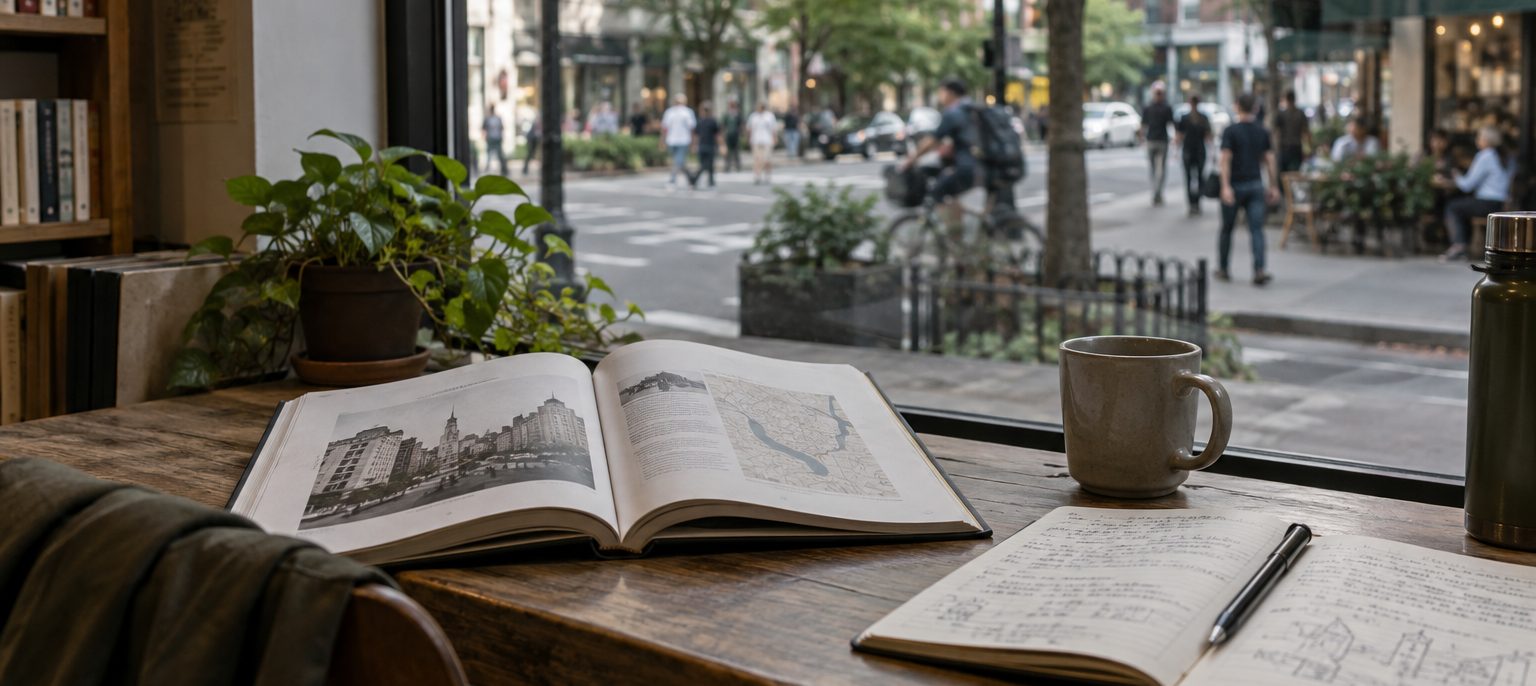
Return from the master plan to daily street life
Cities are often described as roads, buildings, and functional zones. People experience them through sequences of entrances, corners, shops, and walking routes. Twentieth century urban critics redirected attention to streets, showing how dense, repeated, and partly unpredictable use produces vitality.
"Eyes on the street" describes natural attention created by shopkeepers, residents, passersby, and activities along the frontage. Where people remain present and ground floors look outward, strangers can sense everyday care.
Activity gives those eyes a purpose
Extra windows alone do little when ground floors are vacant, residents sit behind parking lots, or all shops close at dusk. People need reasons to be present.
Mixed uses bring overlapping schedules. Breakfast shops animate mornings, offices support daytime visits, schools and community services create regular gatherings, and restaurants and homes extend activity into evenings. Noise, privacy, and affordability also need attention so this vitality serves residents fairly.
Short blocks offer fine choices
Short blocks and frequent junctions provide several routes. People can choose shops and stopping points, while flows from different directions meet. Large enclosed plots funnel movement through a few entrances and can leave long, monotonous walks outside their walls.
Distance and network density help measure walkability, while choice adds another dimension. Alternative routes remain available during roadworks, changing weather, or concerns about safety at night. Such small connections contribute to urban resilience.
Bring older concepts into present conditions
Delivery services, shared bicycles, ride hailing, gated communities, and digital services alter streets. Online convenience removes some reasons to leave home while creating waiting areas for riders, temporary vehicle stops, and parcel storage needs. Ask how the underlying mechanisms have changed.
Riders and guards now contribute to presence on a street. Without places to rest, and when treated only as people to move along, part of that everyday attention is lost. Cameras can help reconstruct events; an open convenience store can provide immediate help.
Read a familiar street through the concept
Observe four questions along a street you use daily:
- When are people present, and when does activity abruptly disappear?
- Do ground floors offer doors, windows, and shops, or parking and walls?
- How many alternative routes and exits can people choose?
- Can people stay without making a purchase?
Map the answers to see activity gathering around entrances, shops, and junctions. Compare morning, afternoon, and night to understand how uses take turns and where gaps appear.
Read the city and revise the theory
Classic writing gives us language for daily life, while observation tests it. High density does not automatically bring vitality, and many shops do not guarantee inclusion. A busy street can still be difficult for children, older people, or those with limited mobility. Use theory to formulate observable questions.
Bring concepts to the street and return with examples that challenge them. Countless people keep using and changing the city, so an understanding of it should remain open.
Reading method: For every urban concept you encounter, find one real example and one counterexample. The gap between them can teach more than the definition alone.