Public Space
Child Friendly Streets Reach Beyond the Playground
A welcoming environment lets children reach places independently, choose their own activities, and take part in everyday neighborhood life.
3 min read
Public Space
A slide alone proves little
A new park may have brightly colored play equipment while the route from home crosses an unprotected junction. Parents may find no seats or toilets, and older children may be told they cannot run or ride bicycles. Beautiful equipment tells us little about whether a city welcomes children.
A child friendly city considers the entire day: school, shopping, waiting for a bus, playing, and getting home. Safety matters alongside opportunities for independent exploration, contact with nature, and participation in public life.
See the street from a child's height
An adult may see a clear road. A child one meter tall may see a metal wall of parked cars. Vehicles at corners block views, high hedges hide approaching traffic, and fast turns leave little time to judge.
Crouching to a child's eye level is a direct way to investigate. Check whether people can see one another at crossings, whether school entrances are surrounded by cars, and whether paths have sudden changes in level. Slower traffic, shorter crossings, and clear corners often achieve more than extra warning signs.
Make room for play throughout the neighborhood
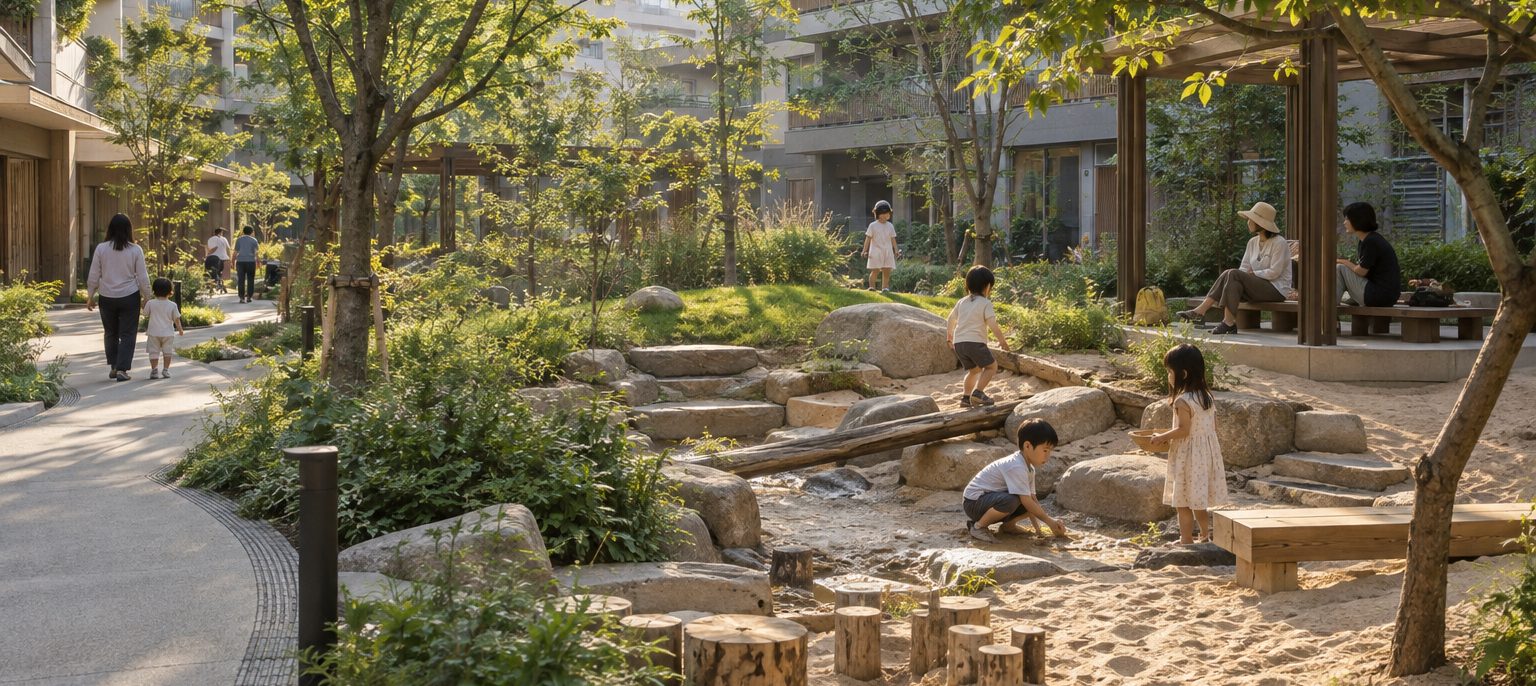
Children learn about their surroundings by chasing, climbing, collecting leaves, and watching insects. Standard equipment offers obvious activities but can limit imagination. A gentle slope, a low wall to sit on or climb, a patch of sand, and a shallow channel with water can support richer play.
Assess risks in levels. Remove traffic conflicts, sharp edges, and unexpected falls. Modest height, speed, and physical challenges can help children develop judgment. A space stripped of every uncertainty loses opportunities for exploration.
Caregivers' needs shape how long people stay
Parents and grandparents need seats with a view of children, shade, drinking water, toilets, and chances to talk with other caregivers. Seats facing away from activities or standing far from equipment leave adults waiting anxiously at the edge and can shorten a visit.
Stroller parking, facilities for babies, and adjacent activities for different ages also matter. Families with siblings of different ages cannot occupy two distant areas at once. Placing varied activities within sight of one another can be more thoughtful than adding equipment.
Ask children to take part
Asking children what park they want can produce requests for more slides. Questions such as "Where do you feel afraid?", "Where would you like to stop after school?", and "Which route can't you walk by yourself?" reveal more. Let children draw routes and photograph places they like and dislike.
Show them what happened to their suggestions. Explain which ideas were adopted, which cannot yet be used, and why. Seeing a connection between their views and physical changes helps children learn how public decisions work.
Begin with a school route
Start within five hundred meters of a school. Record vehicle speeds, views at junctions, continuous sidewalks, waiting areas, and everyday facilities children can reach independently. Observe during arrival and dismissal, when the street is actually in use.
Improvements can be simple: a vehicle free buffer outside the gate, curb extensions that shorten crossings, an open passage through a neighborhood, edges to sit on, and drinking water along the way. Together they create a route children can understand and use.
Try a demanding test: can a ten year old safely get to know the neighborhood with gradually less adult help? A city that allows appropriate independence for children tends to serve older residents, caregivers, and pedestrians better too.
Observation tip: Crouch at three junctions along a school route. Check whether children can see vehicles and drivers can see children. This reveals more than counting cartoon signs.
Related
-
The Direction of a Bench Shapes a Square's Warmth
Public Space