Walking Networks
What Forty Seconds of Waiting Does to a Walk
Waiting at a crossing may look like a traffic setting, yet it changes route choices, street safety, and people's perception of walking distance.
3 min read
Walking Networks
Why forty seconds can feel long
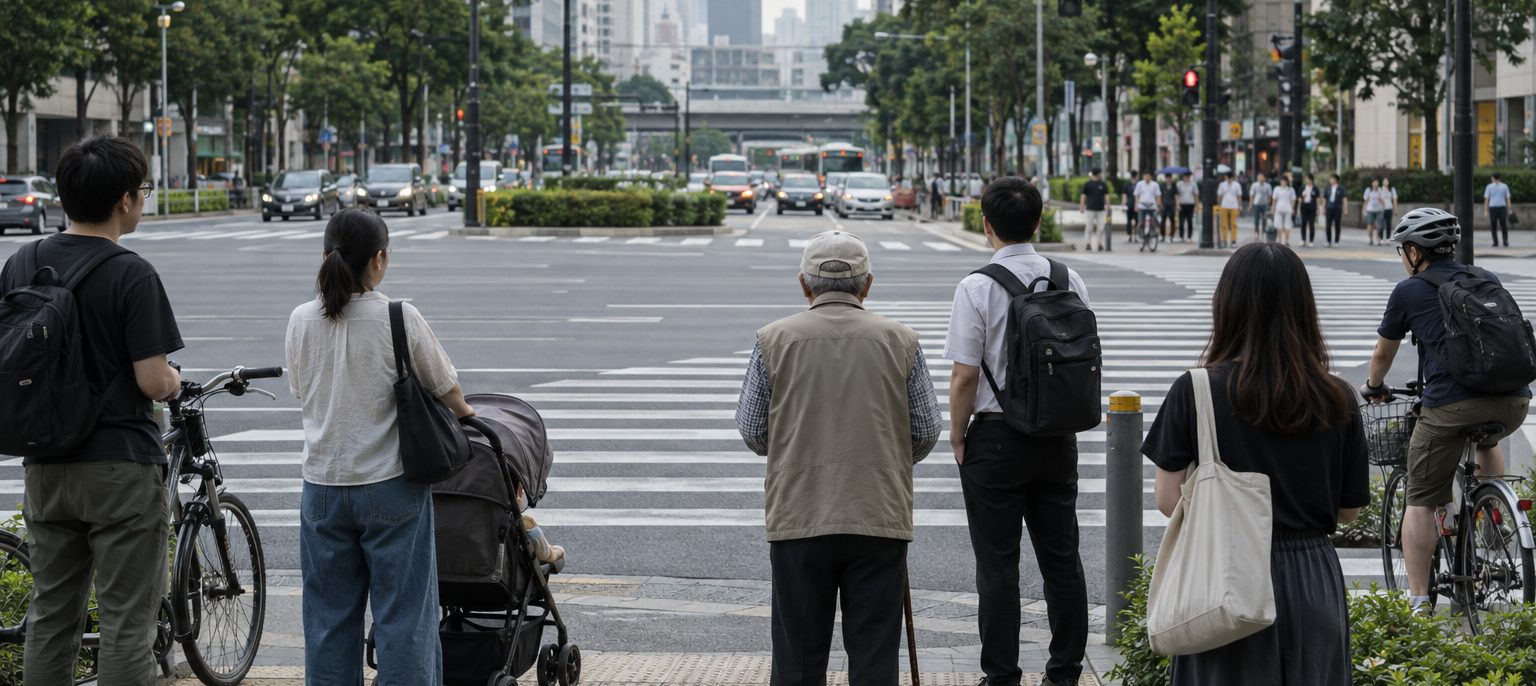
Forty seconds at a junction seems modest on a clock. Without shade, with turning traffic nearby, and without a countdown signal, the same wait can feel like a much longer period of uncertainty. Pedestrians cannot tell whether they just missed the green light or whether the next one will allow them to cross in one go.
If a ten minute walk passes through four such junctions, waiting can account for a quarter of the journey. A map still shows a nearby destination, while the body remembers repeated interruptions. Over time, people may use footbridges, cross unsafely, or choose a bicycle or car.
A signal cycle allocates people's time
Traffic signals divide time between vehicle movement and pedestrians. Long cycles designed to increase vehicle throughput can leave people gathering on narrow refuge islands. Older people and children walking more slowly may be unable to finish before the green light ends.
Assess both the vehicle queues and the pedestrian experience. Record average waiting time, whether a crossing requires two stages, whether people entering near the end of the green phase can arrive safely, and whether turning vehicles keep blocking their path. Put the costs borne by different users in the same table.
The waiting environment changes perceived time
A countdown, shade, and enough standing room can make an equally long wait easier to accept. A narrow refuge, loud noise, and cars turning close by demand constant vigilance. Stress makes time feel longer.
Improvements can include clear countdowns, vehicle stop lines set farther back, yielding by turning traffic, slower corners, and trees. On wide roads, a generous refuge can help, while the option to cross in one phase should remain a design goal.
Different bodies bear different costs
A young person may accelerate as the signal flashes; an older person using a cane may be unable to change pace. Someone pushing a stroller must watch for wheels catching at the curb. A person with a visual impairment relies on audible cues, and a child may struggle to interpret complex traffic. Systems timed around a healthy adult's speed shift risk onto more vulnerable people.
Observe when the first and last pedestrians reach the far side after the green phase begins. Pay particular attention to slower walkers stranded in the middle. Simple timing can turn a feeling that the signal is too short into evidence people can discuss.
Effects beyond the junction
Long waits affect shops and public spaces on both sides of a street. When people avoid crossing for a small shop, the two sides gradually become separate worlds. A bus transfer can fail because of one signal cycle. School entrances can accumulate large groups of parents and children in a short period.
Shorter cycles or phases that prioritize pedestrians can strengthen neighborhood connections. Where demand varies, signals can use different timings at school arrival and dismissal, rush hour, and night.
Try a simple timing exercise
Observe three complete signal cycles. Record waiting time, green time, the number of people unable to cross in one phase, and conflicts with turning vehicles. Then stand on each side of the road and ask: if my destination were directly opposite, would I want to go there?
Forty seconds may be justified. The questions are whether the wait is necessary, predictable, and repeatedly imposed on the same people. Treating pedestrians' time as equally valuable to time spent inside vehicles gives walking the attention it deserves.
Observation tip: Time the whole crossing, from arrival at the junction to safe arrival on the other side, alongside the length of the green light.
Related
-
A Fifteen Minute Neighborhood Begins with Real Walking Routes
Walking Networks